
Showing posts with label jungle trekking. Show all posts

Monday, December 31, 2012

Danum Valley retreat (15-18 Oct 2012)


Danum Valley is a large forest reserve owed by Yayasan Sabah located in Sabah, Malaysia. It is part of the large piece of rainforests given by the Sabah government to Yayasan Sabah. About 14% of the land was reserveed as  forest conservation area while the rest was logged in the past. Danum Valley aims to cover half of its expenses using revenue from eco-tourism.
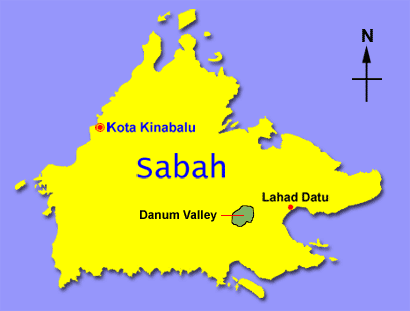


I was very fortunate to visit Danum Valley from 15- 18 Oct 2012 for a retreat with my supervisor and labmates. We were invited by one of the co-founder, Mr. Cyril Pinso to visit the facilities. The fastest way to get to Danum Valley is to take MASwing flight from Kota Kinabalu to Lahad Datu airport and then 1.5-2 hours 4WD drive from the airport to Danum Valley. Danum Valley is largely unknown to many Malaysians, at least not until Prince William and Duchess of Cambridge visited it on 15 September 2012.

Upon arrival at around 7pm, we checked in at the reception building. We were informed that there is no phone reception and internet connection (except for a very expensive fee). Electricity is only available from 7am to 12am midnight. Breakfast, lunch and dinner are available in the cafe at 7am, 12pm and 7pm respectively. Drinking water, tea, coffee, snack are available in the cafe. Packed lunch can be arranged upon request. 

Facilities at Danum Valley (clockwise from top left): cafe, laboratory, reception and view in front of resthouse


The facilities at Danum Valley include reception, cafe, laboratory, staff houses, hostels and resthouse. There are two types of accommodation, namely resthouse and dorms. There are 8 rooms in the resthouse which is located right next to the cafe. There are female and male dorms, each consists of 80 beds (if not mistaken). The dorms are close to the staff housing area and football field, about 10 min walk away from the cafe. The room facilities in the resthouse exceeded my expectation! Towel, toilet tissue, kettle and cups were provided.  Since hot shower is not available, I have to use the kettle to boil water because the water is quite cold. The accommodation rates are affordable but a more expensive rate applied to all international visitors. 

Some of the interesting activities to do are jungle trekking, night walk and sunset/sunrise tour. There are several trails that can be explored such as nature trail, orchid trail, coffin trail, Tembeling waterfall trail, a 6-day trail to Borneo Rainforest Lodge. All trails except nature trail and orchid trail requires a guide. Borneo Rainforest Lodge is a high-end nature resort located near Danum Valley. An attraction near the Borneo Rainforest Lodge is the tree canopy walk. There are several tours available such as night drive tour, sunset and sunrise tour. A 4WD has to be hired for the tours and therefore, it will be better to have at least 4 persons to share the cost. 

On the second day, we explored the coffin trail together with a group of German tourists in the morning. The trail was named coffin trail because a burial site with ancient wooden coffins can be found at the end of the trail. The patterns carved on the coffin resemble Chinese patterns and furthermore, these coffins were located right next to the riverbank, suggesting Chinese origin. First, we crossed the Segama river using a hanging bridge and walked about 2 km to get to the burial site. The burial site also consists of vases and potteries. The coffins were so much smaller than I expected. 

Coffin trail

After completing the coffin trail, we walked back to the cafe for lunch but we stopped at the sights of ORANGUTAN!!! One female adult with a baby were spotted at a rambutan tree right in front of the resthouse. The mother was eating some raw rambutan fruits while the baby was waiting. Initially the baby was trying to catch up with its mother. After 15 min, the baby looked bored and tired so the mother carried the baby and went back into the forest. Observation of the interaction between the mother and child is an amazing experience because their behaviour resembles human behaviour a lot. The first time I saw an wild orangutan! 

Adult orangutan with a baby spotted at a rambutan tree near the cafe


In the afternoon, we explored the nature trail on our own. Nature trail is a well-maintained trail with signboards close to the resthouse. We stopped by the viewing platform to take some photos. At the end of the trail, we saw the tree platform but unfortunately, it was closed for maintenance. After walking the trail, some labmates and I went to the small river behind the cafe to chill out. We then had dinner and retired early for the day. 

On the third day, we woke up for a sunrise tour at 5am. We were picked up by two 4WDs to a viewing platform. We climbed up to the platform and waited in the dark. At this hour, the forest was covered in thick mist. As the sky brighten, the noises of the birds and animals got louder. The first beam of sunlight slowly appeared from the horizon and turned the sky into red flames. But in the next few minute, the sun quickly emerged from the clouds. We were able to see the big and round burning sun hanging above the forest and clouds for a few seconds before the sun became too glaring for our naked eyes. 


Sunrise tour


After breakfast and a short rest, we decided to go to the Tembeling waterfall. The trail is about 6 km return and poses  more challenges compared to coffin trail and nature trail. When we finally reached the waterfall, we had to take off our shoes to cross the river. The waterfall is a decent waterfall with about three-storey height. Some of us climbed over slippery rocks to stand under the waterfall. There is a small catchment pond with water level up to my waist. We spent some time playing with water before we headed back to the resthouse. 

Tembeling waterfall

After dinner, all the guests were given Powerpoint presentation to introduce us to the history of Danum Valley. Then, I followed one tourist on a night walk around the facilities in search for night animals. I was very fortunate to spot a mousedeer, two types of civets and a large frog. It is an eye-opening experience and made me realized that night walk is the best way to spot the animals. 

The whole experience in Danum Valley was amazing. 3D2N was too short a trip. It is the first time I have been up close and personal with so many wild animals. These animals were roaming freely near the facilities and were used to human presence. I would definitely recommend this place to all nature lovers.

Read more...

Tuesday, July 14, 2009

FST Open Day: Kembara Hutan Bangi


"Bangi forest reserve (Hutan Simpan Bangi, adjacent to Universiti Kebangsaan Malaysia (UKM) Bangi campus, is a lawland secondary dipterocarp forest with a size of 100 hectares, which provides lush greenary freshness to UKM Bangi campus. Small forest reserve, ponds, swamps and hill slopes can be found in the forest reverse. The forest reserve is accessed via a 2 KM jungle trail for visitors to enjoy the beauty of flora and fauna of the forest reserve. Bukit Rupa is the highest peak of the forest reserve with an altitude of 105 m from sea level. The Fernarium located within the forest reserve is a site for collection of many fern species collected by researchers and scientist at UKM. Also situtated in the forest reverse is Hutan Pendidikan Alam UKM, which is a centre for cocurriculum activities of various UKM organizations. The co-curriculum centre is equipped with halls, bathroom, camp site and other amenities for training. Bangi Forest reverse houses more than 600 plant species and more than 800 faunal species including small mammals, reptiles, amphibians, fishes, insects etc. The richness of flora and fauna, and the various ecosystems have made Bangi Forest reserve an excellent site for teaching, research and recreation in UKM. "

The above description of Hutan Simpan Bangi came from the brochure given at the exhibition booth. In conjunction with FST Open Day, two jungle trekking sessions (10am and 2pm) are offered to visitors for FREE each day. A UKM bus will drop visitors at the Bangi Lama entrance. Then, they will take 1-1.5 hour journey across Hutan Bangi to reach another entrance point near UKM Law Faculty. This short jungle trekking trail is suitable to people to all walk of age. However, you must seek permission before entering this forest reserve.

Route to Bukit Rupa

My labmates and I signed up for the morning session. We were joined by two big groups of secondary school students and teachers. After a brief explanation by the guide, we head into the jungle. The guide stopped us at a number of trees to educate us about its uses. Several valuable species such as Jelutong, Gaharu and Tongkat Ali can be found here. The guide demonstrated burning a piece of Gaharu bark tissue to give off a nice fragance. He also cut down some young Palas leaves to show us that how to harvest Palas leaves used in wrapping ketupat.

Palas or Licuala spinosa

As we trek down the path, I realized the surrounding plants are mainly palm species such as Palas, Bertam, Salak and Rattan. Low species diversity, high density and wide distribution suggested that the forest has been badly damaged in the past. During Japanese occupation (1942-1945), 90% of the forest was cleared. Although reforestration was done, the forest never recover its valuable timbers. Some common indications of reforested areas are presence of lowland ferns and Senduduk (Melastoma malabathricum).

All the information about Hutan Bangi can be found here.

Read more...

Sunday, April 12, 2009

Fungi diversity at Taman Negara Merapoh

Fungi is a common sight in Taman Negara Merapoh. You can find different types, colour and morphology of fungi or mushroom along the trail. I'm no expert in mycology but I can tell that the fungi diversity is high. Many species that can be hardly spotted are found here. So get ready your camera to snap some really nice pictures!

We discovered at least 20 species of fungi during our 2-day jungle trekking including a rare mushroom like Dictyophora sp. or Stinkhorn.


The forest floor and almost every fallen tree trunks are covered with mushrooms. The sight of it is just amazing. This is what people call mushrooms after the rain.


We stumbled upon this special fungus when we took a wrong turn. It has grey whitish fruiting bodies and a black middle stalk with buddings shaped like asparagus in the middle.


My favourite photo is the C. tricholoma or red cup fungi.


There are many more photos that I would like to share because I realized that there's little online information on tropical forest mushroom. However, it's impossible to post all. Photos are available upon request (for education and research purposes only).

Read more...

Tuesday, April 7, 2009

Taman Negara Merapoh: introduction

Taman Negara is the oldest national park in Malaysia. It’s established in 1938-39. It was named King George V National Park when it first started. It covers a total area of 4,343 km2 spreading over three states (Pahang, Kelantan and Terengganu). The two main entrances to Taman Negara are Kuala Tahan and Merapoh. Taman Negara holds the highest peak in Peninsular Malaysia, Gunung Tahan which is 2,187m above sea level. Here’s the activities you can do:


Jungle trekking – There are 6 trails to choose from: Rentis Interpretif (535m), Rentis Palas (1.6 km), Rentis Gajah (5.5km), Rentis Negeram (4.1 km), Rentis Bunian and Rentis Berjalan Malam (nightwalk). Rentis Interpretif and Rentis Palas are short and located near the campsite. Suitable for the kids' education purposes because the trees on the path are labeled. Thanks to iClub members plant labeling effort. Rentis Gajah is more challenging. This trail will bring you to Gua Gajah and it takes at least 2 hours. to get there It’s forbidden to go without a guide!


Ikan Kelah fish sanctuary – Take a 4WD to Kuala Juram (14 km away from main campsite) to reach Sungai Juram where Ikah Kelah awaits you. Here, you can feed Ikan Kelah or Malaysian Mahseer (Tor Tambra) . If the water is clear, you can see the ikan Kelah swimming against the current with their mouths wide open. In addition, you can see the fish up close at the Ikan Kelah Breeding Centre at the main campsite.


Cave exploration – Two limestone caves can be found in Taman Negara Merapoh: Gua Gajah and Gua Peningat. Gua Gajah is a small cave often visited by the elephants. Along the trail, you can see elephant footprints and droppings. Follow the tunnel in the cave and you will find yourself surrounded by thousands of bats in the dark. Don’t forget to bring torchlight! Gua Peningat is much more larger than Gua Gajah. It’s located further away from the main campsite.

Gua Gajah

Wildlife watching - There are a few watch towers to observe wildlife such as Bukit Seraya (see picture below) and Bumbun Rimau. Menara Tinjau Bukit Seraya is situated on the way to Kuala Juram. It offers a scenic view of Tahan moutain range (picture showed at the bottom). It is restricted to 20 people on the tower at one time. On the other hand, Bumbun Rimau is a popular spot for nightlife watching. It's located just in front of a hangout place for animals like tiger, leopard, mouse deer, Asian golden cat and sun bear. If you're lucky, you'l get to see all the animals. If you're not, come again! There are beds where you can spend the night. You need to take a 4WD and follow a short jungle trekking trail (300m) in order to get there.


Climbing Gunung Tahan – Taman Negara Merapoh is the best way to climb up Gunung Tahan (2,183m) because the trip is shorter (4 days) compared to Kuala Tahan way (7 days). Only 48 people per day are allowed to hike the mountain. Hiring guide is compulsory (RM 950 for 12 persons). Other procedure such as luggage examination is required. Alternatively, you can follow the path from Sg Relau (Merapoh) to Kuala Tahan. Many experienced hikers claim that Gunung Tahan as the most difficult track in Malaysia.

Gunung Tahan view from Bukit Seraya

For more information on other activities and how to get to Taman Negara Merapoh, Click here.

Note: All the facts are given by Perhilitan staff unless otherwise stated.

Read more...

Monday, April 6, 2009

Jom Taman Negara, Jom Merapoh!

It’s been a week since my last post. Last week, I was busy solving Real-time PCR mystery. I spent my weekend at Taman Negara and only arrived home at 11pm last night. Despite all that, I came to work this morning.

The scenic view of Taman Negara Pahang on the way to Kuala Juram

The Taman Negara trip was awesome! Being the oldest protected forest area in Malaysia, it’s a MUST-GO for every nature lovers. There are two main entrances to Taman Negara Pahang: Kuala Tahan and Sg Relau via Merapoh. The entrance we used is Merapoh, a small town north of Pahang which is surrounded by limestone caves. It offers most scenic and tranquil experience to visitors.

Group photo of iClub Taman Negara Camp participators

This trip will not be made possible without iClub. iClub is a new club in UKM and the only one sponsored by an industrial company, GE or General Electric. The club is open to all UKM student regardless of races. iClub is different from other environmental clubs because it organizes various leadership, communication and motivation events to benefit UKM graduates. I’ll keep posting their upcoming activities so stay tuned!

Besides that, this trip is also sponsored by PERHILITAN. Perhilitan has provided us help and accommodation. Although they have limited resources, they are very kind to assist us in every way to make this trip enjoyable. The problems they faced are little funding, lack of publicity and limited staff. iClub has to come up with ways to promote this place and to create public awareness. Therefore, this week I’ll be sharing my experience in promoting Merapoh as the choice of entrance for Taman Negara Pahang. Just look out for many more interesting pictures.

Jom Taman Negara, Jom Merapoh!


Read more...

Monday, March 9, 2009

Jungle trekking in Pulau Redang


The weather is perfect. The sun is shining brightly despite the predicted rainstorm The blue ocean is inviting. The sunlight is reflected on the surface as the sea wrinkles and crawls to the beach. That was my first impression when I arrived at Redang island last wednesday.

I’m sure everyone is familiar with Redang. It is an island in Terengganu famous for its beautiful beaches and rich marine life. Not many people know that actually Pulau Redang is also rich in both flora and fauna. Among the species that can be found are macaque monkeys, mousedeer, monitor lizard, snake, geckos, over 50 species of birds, 84 species of butterflies etc. If you are tired of snorkeling, you might consider spending 2 hours for jungle trekking.

The jungle trekking trail starts from the backyard of Coral Redang Resort and it leads to Berjaya resort. All you need to do is follow the orange TNB (Tenaga National Berhad) pipeline. Also, look out for ropes or tree trunks that are painted in red.

On the second day of my trip, we headed out after lunch. We were lucky because the trail is quite dry. We found a snake skeleton after a mere 5 min walk. As we proceed cautiously, I saw
a Sang Kancil (mousedeer) running away from me after hearing my loud footsteps. The track gets more exciting as we crossed several rivers and climb up the hills. It took us awhile to figure out where is the trail when it’s impossible to walk next the orange pipe.

What amazes me the most is to find a few Monkey cups plants (Nepenthes sp. or pitcher plant). It got its name because monkeys are often spotted drinking water from the plant. These plants growing out from the vines can run several meters. To the Chinese, Monkey cups are signs of prosperity. The local Chinese saying is 朱笼进水十八十八 .When it’s pronounced in Cantonese, it means that if you collect 18 monkey cups, you’ll be rich when the water enters them (This is my translation version). Usually the first thing I'll do is to peek into the cup for any trapped insect and then pour the water out. Old habit hard to die. Monkey cups are rare these days SO PLEASE DO NOT DAMAGE the plant or remove the cup from the leaf!!!

When walking through the forest, always be alert of any surrounding sound. Try to look up the trees when you heard birds chirping. This is how I spotted two exotic bird species with long tails. Due to my "over-sensitiveness", I was surprised several times at the loud noises made by some tiny lizards.

After trekking for 50 mins, we stopped at the sight of monkeys fighting on the trees. We were so close to our destination because we can hear the sounds of waves crashing onto the shore! Yet, we have no choice but to head back to the resort for our 2.30 pm snorkeling trip.

I would say that this trail is a bit challenging because there’s a place that is very steep. You need to hold on to the ropes which had been tied to the trees to get down the hill. I have done even steeper trekking in Hulu Langat last year at NIGHT! If I were to rank this trail, I would give it a 7 in terms of challenge and 9 out of 10 in terms of biodiversity. One of the best adventures I had because there’s so much to see.

Note:
Unfortunately, I wasn’t able to visit the turtle sanctuary in Redang because according to the resort staff, that place can only be reached by boat. The turtle volunteer program is offered every year. For more information, visit www.umt.edu.my/turtle.

Read more...

  © Free Blogger Templates Spain by Ourblogtemplates.com 2008

Back to TOP